
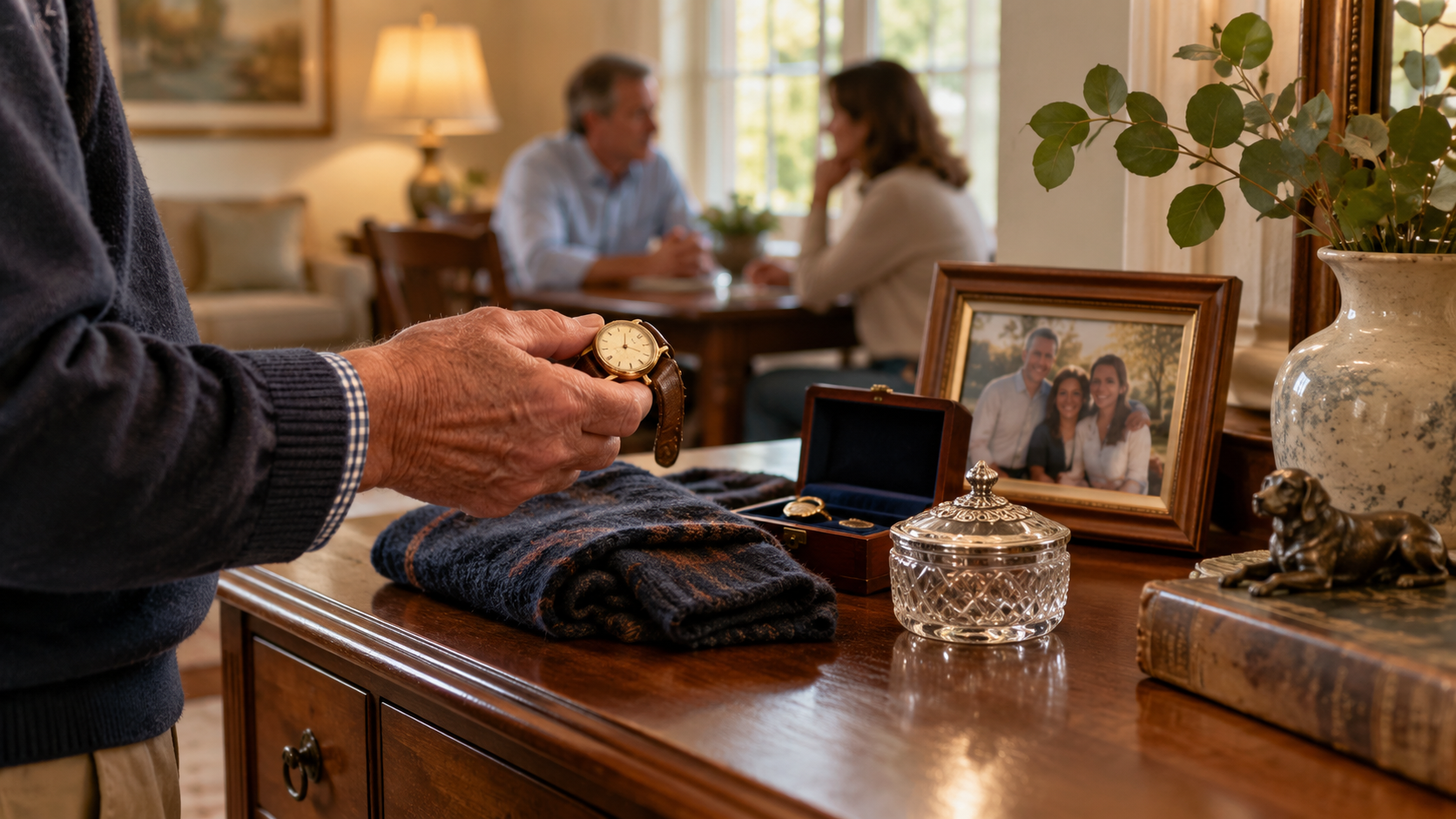
When Robin Williams died, many people assumed his estate plan would make everything straightforward. He had substantial assets, trusts, and a family he had planned for. Yet one of the disputes that followed involved something many families overlook: personal belongings.
That is a useful reminder for ordinary Texas families.
The hardest issues after a death aren’t always bank accounts or investment balances. Sometimes they involve a watch, a ring, a photograph, a piece of furniture, or a collection that may not mean much to anyone outside the family but means a great deal to the people left behind.
That is why personal property deserves more attention in estate planning than it often receives.
Personal belongings can create real conflict
Most people understand that an estate can include a house, financial accounts, life insurance, or retirement assets. But an estate also includes the personal items that filled a person’s life.
These may include:
- jewelry
- family photographs
- artwork
- furniture
- firearms
- tools
- collectibles
- clothing
- keepsakes
- household items with sentimental value
In many families, those items create more disagreement than expected.
A will may say that the estate is to be divided equally among three children. That sounds simple on paper. But equal shares don’t automatically answer practical questions like who gets a wedding ring, a favorite watch, a grandfather clock, military medals, or the family photo albums.
Those items cannot always be divided neatly, and their emotional value is often much greater than their market value.
Why the Robin Williams estate still matters
The dispute involving Robin Williams and his family was not just a celebrity story. It highlighted a problem that appears in many estates, including modest ones.
A surviving spouse may believe certain personal items belong to them because they were part of the shared home and married life. Adult children may believe some of those same items were meant to pass to them through the estate. If the documents are unclear, or if expectations were never discussed, disagreement can follow.
That problem is not limited to large estates.
A Texas family may face the same issue over a watch, a wedding ring, a set of dishes, a hunting rifle, or an old box of letters. Legal fees and emotional strain can become disproportionate to the property’s dollar value.
Personal property needs its own planning
Many people spend most of their planning time thinking about the “big” assets. That makes sense. But personal belongings often need separate attention.
A good estate plan should consider not only who receives major financial assets, but also whether certain possessions should go to specific people.
That does not mean every item in the house needs to be listed.
Most families do not need a detailed legal provision for every chair, lamp, or dish. But certain items often deserve specific instructions because they are valuable, sentimental, or likely to become the subject of disagreement.
Examples may include:
- family heirlooms
- jewelry and watches
- firearms
- antiques
- collections
- artwork
- photographs and family records
- tools or equipment tied to a trade or hobby
- items that have already been promised to a child or grandchild
If those things matter, don’t treat them as an afterthought.
Texas law helps, but it does not solve everything
In Texas, a will or trust can direct who receives personal property. But the documents must be clear enough to make those instructions meaningful in real life.
A general clause leaving property equally among children may not answer who receives a particular heirloom. A broad clause giving someone a house does not automatically mean that person receives everything inside the house. Title, ownership, and the wording of the governing documents all matter.
That becomes even more important in blended families and second marriages.
A person may want a surviving spouse to remain in the home and continue using certain household items, while also wanting children from an earlier marriage to receive specific possessions later. That can be done, but it requires careful thought.
It is also important to remember that Texas is a community property state. Some property may be community property, while other items may be separate property because they were owned before marriage or received by gift or inheritance. In some situations, determining ownership is part of the difficulty.
As a result, no single rule fits every family. The right approach depends on family relationships, the nature of the property, how it was acquired, and what the existing documents say.
A common family scenario
Imagine a widower in Texas with three adult children. He has a will leaving his estate equally to the children. He later remarries and shares a home with his new wife.
Over the years, the home contains a mixture of belongings. Some items came from his first marriage. Some were inherited from his parents. Some were acquired during the second marriage. Some have sentimental value to the children because they remember them from childhood. Others are used daily by the surviving spouse.
If he dies without clear instructions, everyone may understand what should happen differently. The surviving spouse may believe certain items should remain with her. The children may believe some of those items were always intended to stay in their side of the family.
That kind of uncertainty is exactly what better planning can reduce.
Informal promises are often not enough
One reason these disputes arise is that people make casual promises over the years.
A parent may say, “That watch will be yours someday,” or “I want you to have the photo albums.” The problem is that other family members may not know about the promise, may remember it differently, or may have been told something similar about the same item.
Informal conversations can help, but they don’t replace clear planning.
Likewise, a handwritten note or list may express wishes, but it may not fully solve the problem unless it fits properly with the person’s estate-planning documents and the applicable legal requirements.
If you want to direct important items to a specific person, the safer course is to address them legally as part of the overall estate plan.
Communication matters too
Documents matter, but so does communication.
In many families, it is useful to identify the possessions most likely to matter and discuss them in advance. That does not require a dramatic family meeting or disclosure of every financial detail. It may simply mean clarifying your intentions while you can explain them.
That kind of conversation may reduce surprise and make later decisions easier.
Of course, not every family should handle this the same way. Some families communicate openly. Others have strained relationships or more complicated histories. In those situations, careful planning becomes even more important.
A practical next step
If you already have a will or trust, take a few minutes to think beyond the major assets.
Ask yourself:
- Are there personal belongings that are especially important to particular people?
- Have I clearly identified them?
- Do my current documents deal with them adequately?
- Would my family know what I intended?
For many Texas families, that simple review is worthwhile.
Personal belongings often carry family memories, identity, and meaning. They may not be the largest part of an estate, but they can be the most personal part. Giving them deliberate attention now may help your family avoid confusion and disagreement later.
Harvey L. Cox, Texas Estate Planning Attorney, has more than thirty-five years of practice and helps Texas families think through practical estate-planning issues, including how to address the personal belongings that often matter most.